Training · Oct 28, 2026
Walking lunges show the leg your squat is hiding
A squat trains both legs at once. A lunge that travels forward shows which side is actually doing the work.
YourFit · Walking lunge · Quads, hamstrings, glutes
A squat can hide a lazy leg. Both feet stay down, both sides push, and the stronger leg quietly takes the extra share. A walking lunge will not allow that. One foot is in front, the back knee is traveling toward the floor, and whichever side is sloppy shows up within a few steps.
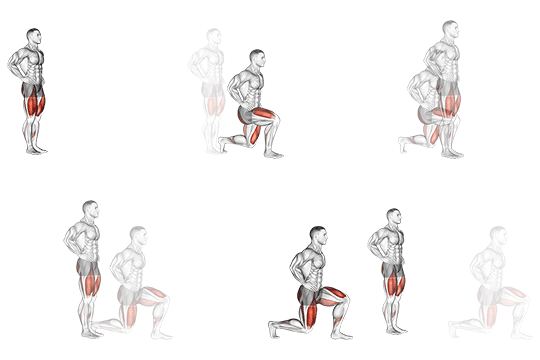
The gif is the traveling version, not a stationary split squat. You step forward, lower under control, then drive through the front foot into the next step. It needs almost no equipment, which is why it sits in the basic YourFit workout next to the squat.
The step is the exercise
Start standing, feet together, torso tall. Take a step long enough that the front heel can stay down when the back knee bends. A tiny step turns the lunge into a knee-over-toes stumble. A huge step you cannot balance is just as useless. The front shin stays close to vertical at the bottom.
The back knee travels down, not the chest. You are lowering yourself between the two feet, then standing on the front leg to take the next step. The torso stays tall. If the shoulders dive toward the front knee, the step was too short or the weight in the hands is running the show.
What you are supposed to feel
Most of the work lands in the front thigh and the glute of the front leg. The back leg is a rudder, not the engine. People also feel their balance, which is the point. A lunge that never threatens your balance is usually a lunge that never went anywhere.
One side is almost always cleaner. That is information. Do not quit, and do not only train the pretty side. Shorter steps and lighter dumbbells fix a messy side faster than forcing a long stride you cannot own.
The cheats
Bouncing the back knee off the floor turns the lunge into a pogo stick. Pushing off the back toes, instead of the front foot, lets the rear leg do a job it was not given. A torso that folds forward lets you use momentum and the lower back to stand up.
The other common one is a different step length on each side. The right leg gets a real stride and the left gets a shuffle, then the log says ten lunges a side. They were not the same lunge.
Empty hands first
Learn the walk with empty hands. When the steps are even and the front heel stays down, hold a light dumbbell in each hand, arms straight. The weights should not swing. If they swing, you are using them to throw yourself into the next step.
Make it harder by slowing the lowering, or by pausing for a second at the bottom with the back knee hovering, not resting. More steps come before heavier dumbbells. A longer walk of clean steps beats six heavy ones that change shape.
Count one thing, every time
Count steps, or count pairs of steps, and write the same unit every time. Ten steps is not ten pairs. Mixing them makes a month of training impossible to read. If you add dumbbells, write the weight in each hand next to the step count.
YourFit keeps the walking lunge in the basic workout so the gif and the history stay attached. Next time, add steps, then add load, then slow the lowering. Do those in that order.
What to watch
- Step far enough that the front heel stays down.
- The back knee travels down. The chest does not.
- Drive through the front foot into the next step.
- Keep the same stride on both sides.
- Count steps or pairs, and never switch the unit.