Training · Nov 9, 2026
Self Assisted Inverse Leg Curl: A Repeatable Range Makes Reps Comparable
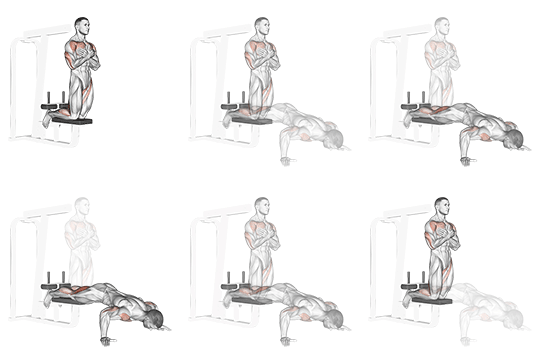
Keep your support, range, and lowering pace consistent. A higher rep count only means progress when those standards stay the same.
YourFit · Self assisted inverse leg curl · Hamstrings
The self assisted inverse leg curl is listed as a hamstring exercise, with a back-lying setup and a controlled return to extended legs. Treat that description as your standard: establish the starting position, complete the knee bend and thigh movement, pause, and lower without rushing to collect another repetition.
The useful challenge is making your last repetition look like your first. More repetitions mean little if the range gets shorter or the pause disappears. Choose a version you can repeat cleanly, keep the support position consistent, and record enough detail to know whether next week’s improvement is real.
Set a repeatable start
Lie flat on your back on a mat or bench, with your legs extended. Place your hands by your sides or under your glutes for support. Both hand positions are included in the description; choose one rather than switching casually during the set. Before beginning, notice what your extended starting position looks and feels like. That is the position you will return to after each repetition, not merely the position you use before the first one.
Do not turn the setup into a search for an unlisted adjustment. There is no need to assign a precise angle or add equipment to make the exercise sound more technical. Your useful setup decisions are the surface you use, the permitted hand position you choose, and the range you can control. Keep those decisions stable for the set. If you change one between sessions, record it so you do not mistake a different setup for an improvement in performance.
Finish the whole repetition
From the extended position, bend your knees and lift your feet off the ground, bringing your thighs toward your chest. Treat this as one continuous repetition rather than racing through separate pieces. Reach the top of the range you have chosen and pause for a moment. The pause gives you a clear finish to the lifting portion. It also makes it easier to notice when later repetitions stop reaching the same point as the early ones in the set.
After the pause, slowly lower your legs back to the starting position. Do not count the repetition at the top and then give away the return. The repetition is complete when you have lowered back to the extended start under control. Use a lowering pace you can reproduce rather than an elaborate timing rule you cannot maintain. Before starting the next repetition, check that you actually reached your starting position instead of quietly shortening the bottom of the movement.
Do not count a shrinking range
The easiest way to inflate your number is to let the movement get smaller as the set continues. You may bring your thighs less far toward your chest, stop the return before reaching the extended start, or do both. The counter still goes up, but the repetitions no longer describe the same task. Watch the two ends of the movement. A consistent top and a consistent return tell you more than a high total assembled from progressively shorter repetitions.
Rushing is another way to disguise the change. If the pause disappears and the lowering becomes a quick drop, you have changed the standard even if the movement still looks broadly similar. End the set when you can no longer repeat your chosen range with the pause and controlled return. If you continue with a reduced range, record those repetitions separately. They should not be folded into the same total and presented as though every repetition met the original standard.
Make range the adjustment
For an easier version, use a smaller range that you can control rather than forcing a larger movement and losing the slow return. Keep the same back-lying setup and one of the listed hand positions. Define the reduced range before the set so it is a deliberate variation, not a range that shrinks unpredictably. Pause at its top and lower slowly. Record it as reduced-range work; it gives you a usable starting point without pretending that it matches the full described movement.
For a stricter version, work toward the complete described repetition: start with extended legs, bend the knees and bring the thighs toward the chest, pause, then lower slowly back to the extended start. Make the endpoints and pause more consistent before chasing a larger total. Stricter does not require a new implement or an invented body position. Here, it means removing the shortcuts that previously let you keep counting after your chosen standard had already begun to break down.
Log the standard and the count
Write down the exercise name, the surface used, your hand position, and the repetitions completed in each set. Add a brief range description, whether you paused at the top, and how you controlled the lowering. Plain language is enough: “extended start, thighs toward chest, brief pause, slow return” is more useful than a bare total. If you used a reduced range, describe its endpoints clearly enough that you can choose the same version again instead of guessing from memory.
The number comparable next week is the count of repetitions completed with the same setup, range, pause, and lowering pace. Compare corresponding sets rather than selecting whichever total looks best. For example, nine repetitions do not clearly beat eight if the ninth session uses a shorter return or drops the pause. Note where the standard first slipped, and keep any extra partial repetitions separate. When those conditions match, an additional completed repetition is a straightforward improvement you can actually use.
What to watch
- Keep one hand position.
- Bend knees; bring thighs toward chest.
- Pause at the top.
- Lower slowly to the extended start.
- Count only matching repetitions.